
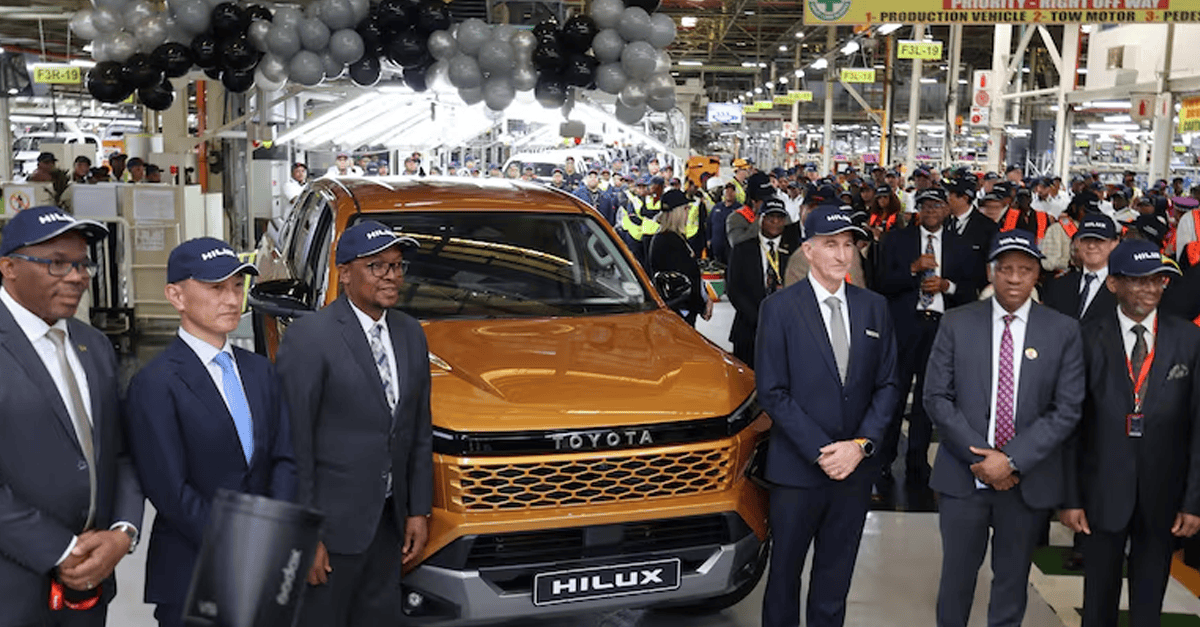
Toyota South Africa Motors has committed R10.4 billion to produce the ninth-generation Hilux, a move President Cyril Ramaphosa calls a strong vote of confidence in the nation's economy. The investment, one of the largest in the country's automotive sector in recent years, is expected to create thousands of jobs, boost exports, and reinforce South Africa's position as a key player in global vehicle manufacturing. For Nigeria and other African nations eyeing similar industrial growth, the deal offers lessons in how policy stability, infrastructure investment, and strategic partnerships can attract major capital flows.
The Scale of the Investment
Toyota's R10.4 billion (about $560 million) will be spent over five years, beginning in 2024, to upgrade the Durban plant where the Hilux is assembled. The investment covers new tooling, robotics, and training for the workforce to handle the ninth-generation model. According to Toyota South Africa CEO Andrew Kirby, the plant will see the installation of 200 new robots, a 30 percent increase in automation, and the retraining of 3,500 workers. The Hilux has been South Africa's best-selling vehicle for 15 consecutive years, with 45,000 units sold domestically in 2023 alone. The new version is expected to be exported to over 100 countries, with annual export volumes rising from 70,000 to 85,000 units. This is not a small bet. It is a long-term commitment that will ripple through the local supply chain, from component makers to logistics firms.
President Ramaphosa, speaking at the announcement in Pretoria on March 12, 2024, said the investment demonstrates South Africa's ability to convert investment commitments into tangible outcomes: jobs, industrial growth, and export earnings. The government has offered incentives through the Automotive Production and Development Programme (APDP), which rewards local content and export volumes. Under the APDP, manufacturers earn credits for each vehicle exported, which can offset import duties on raw materials. Toyota's decision suggests the program is working. The company already sources 40 percent of its components locally, and with the new investment, it aims to push that figure to 50 percent by 2028.
Why This Matters for Africa
South Africa accounts for roughly 60 percent of Africa's vehicle production, producing 633,000 units in 2023. But other countries, including Nigeria, Ghana, and Morocco, are trying to boost their own automotive sectors. Morocco, for example, produced 700,000 vehicles in 2023, mostly for export to Europe, thanks to its free trade agreements and proximity to the EU. Nigeria's National Automotive Industry Development Plan (NAIDP) aims to revive local assembly and attract foreign manufacturers. However, challenges like erratic power supply, poor roads, and inconsistent policies have scared off investors. Nigeria's vehicle production fell to just 10,000 units in 2023, down from 14,000 in 2019, as several assembly plants, including those of Nissan and Ford, scaled back operations.
Toyota's investment in South Africa shows what is possible when a government provides clear, consistent incentives and reliable infrastructure. The Durban plant benefits from a well-maintained port, stable electricity (with less than 50 hours of load-shedding per month on average in 2023), and a skilled workforce. These are not luxuries. They are prerequisites for any country hoping to host a modern auto plant. For comparison, Nigeria's ports suffer from average vessel waiting times of 20 days, while South Africa's Durban port averages 3 days.
Toyota's R10.4 billion investment in South Africa's Hilux production is a clear signal that the country remains a competitive destination for automotive manufacturing in Africa, thanks to its policy stability, infrastructure, and skilled labor force. The investment also underscores the importance of the African Continental Free Trade Area (AfCFTA), which could reduce tariffs on auto parts and finished vehicles traded within Africa, making regional supply chains more viable.
The Hilux as an Export Powerhouse
The Hilux is not just a domestic favorite. It is a global icon, sold in over 180 countries. Toyota's decision to build the ninth-generation model in South Africa rather than Japan or Thailand underscores the plant's efficiency and quality. The company says the upgraded facility will increase production capacity from 120,000 to 140,000 units per year and improve export volumes. Current exports account for about 70 percent of the plant's output, mostly to Europe (30 percent), Australia (20 percent), and other African markets (15 percent). In 2023, the Durban plant exported 85,000 Hilux units, generating $2.1 billion in revenue.
For South Africa, this is a major foreign exchange earner. The automotive sector is the country's largest manufacturing subsector, contributing about 6 percent to GDP, or R300 billion in 2023. Every direct auto job supports an estimated seven jobs in the supply chain and services. So a R10.4 billion investment does not just secure 3,500 jobs at the plant. It sustains an estimated 24,500 workers at parts suppliers, transport companies, and dealerships. The multiplier effect is significant: for every rand invested, the economy gains R3.50 in output, according to the National Association of Automobile Manufacturers of South Africa (NAAMSA).
Challenges Remain
Despite the good news, South Africa's auto industry faces headwinds. Labor costs are relatively high compared to some Asian competitors. The average wage for an auto worker in South Africa is R25 per hour, compared to R15 in Thailand and R10 in India. The country has also struggled with frequent power cuts in recent years, though the government says it is addressing the issue. In 2023, Eskom implemented load-shedding for 200 days, costing the economy an estimated R500 billion. Toyota's investment includes R200 million for on-site solar power generation and battery storage, capable of supplying 20 percent of the plant's peak demand.
Another challenge is the global shift toward electric vehicles (EVs). South Africa currently produces mostly internal combustion engine vehicles. The country has no major EV battery plant and limited charging infrastructure, with only 300 public charging stations nationwide. Toyota's investment in the Hilux, a diesel and petrol model, could be seen as a bet that demand for these vehicles will remain strong for another decade or more. But some analysts worry South Africa may miss the EV transition if it does not start preparing now. The government has launched an EV policy framework, but it lacks concrete incentives for production. In contrast, Morocco has attracted $1.5 billion in EV battery investments from companies like Gotion High-Tech.
What Nigeria Can Learn
Nigeria has ambitions to become an auto hub. The NAIDP offers tariff breaks for local assemblers and aims to boost local content to 40 percent by 2025. But the policy has been inconsistently applied, and many assembly plants operate far below capacity. For instance, the Volkswagen plant in Lagos produced only 2,000 units in 2023, against a capacity of 5,000. The country's poor road network and port congestion add to costs: clearing a container at Apapa port takes an average of 14 days, compared to 3 days in Durban.
Toyota's South Africa investment shows that a competitive auto industry requires more than tax breaks. It needs reliable electricity, efficient ports, and a skilled workforce. Nigeria is working on all three, but progress is slow. The government could study South Africa's APDP model, which ties incentives to actual production and export performance. Nigeria could also learn from Ghana's approach, which offers a 10-year tax holiday for new assembly plants and has attracted Suzuki and Volkswagen to set up operations.
The Bigger Picture
Toyota's R10.4 billion is not just a corporate investment. It is a vote of confidence in a country's economic management. For South Africa, it comes at a time when growth is sluggish (0.6 percent in 2023) and unemployment is high (32.1 percent). The deal will help restore investor sentiment and demonstrate that the country can still attract big-ticket manufacturing projects. The investment is expected to boost GDP by 0.2 percent over the next five years, according to the South African Reserve Bank.
For the rest of Africa, it is a reminder that the continent can compete for global auto manufacturing dollars, but only if it gets the basics right. The Hilux will roll off the Durban line for years to come, a symbol of what is possible when policy, infrastructure, and industry align. As African countries push for industrialization under the AfCFTA, they would do well to study the South African model, which combines government support with private sector efficiency. The road ahead is long, but Toyota's bet shows that the destination is worth the journey.