
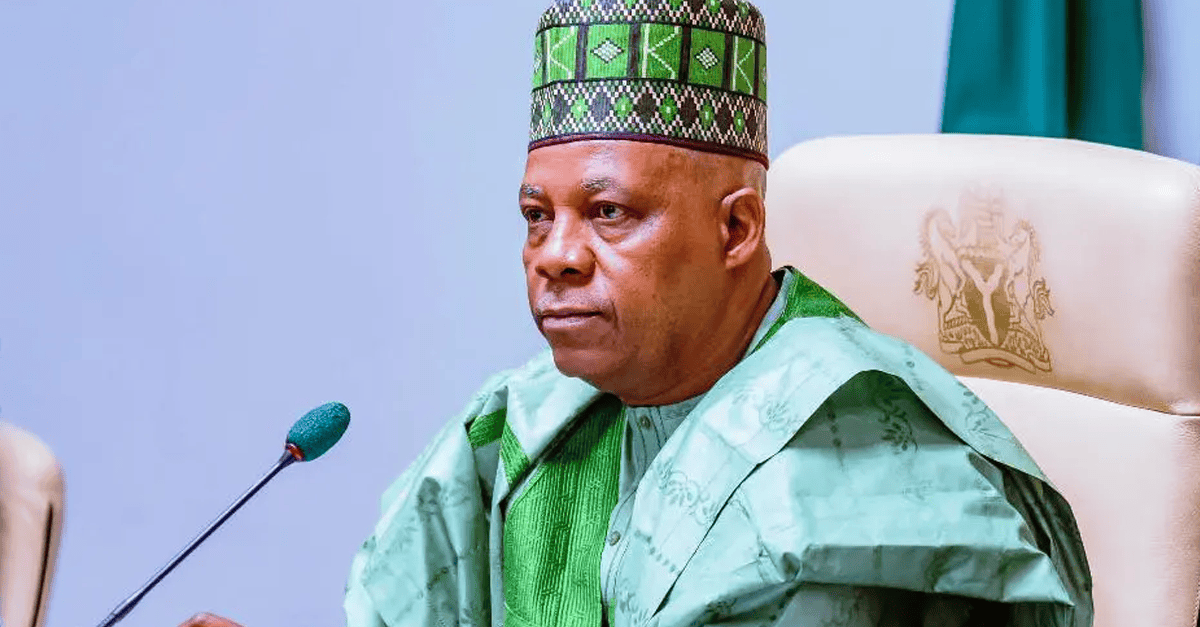
Vice President Kashim Shettima stands at a crossroads that few Nigerian politicians have navigated successfully. As President Bola Tinubu prepares for a potential second term, the question of whether Shettima will remain on the ticket has become a defining issue. For a man who has served loyally since 2023, the uncertainty is not unfounded. Tinubu's own record as Lagos State governor from 1999 to 2007 tells a cautionary tale: he used three different deputies, Kofoworola Bucknor-Akerele, Femi Pedro, and Abiodun Ogunleye. Only Senate President Godswill Akpabio, during his tenure as Akwa Ibom governor, matched that turnover. For Shettima, the path to renomination is not guaranteed.
The stakes are high. Shettima's performance in office, his political alliances, and the internal dynamics of the ruling All Progressives Congress (APC) will all influence Tinubu's decision. But beyond personal ambition, this moment tests the stability of Nigeria's vice-presidential succession and the president's willingness to break with past patterns.
The Tinubu precedent
Bola Tinubu's governorship in Lagos was marked by pragmatism. Each deputy served a distinct purpose. Bucknor-Akerele, a woman from Lagos Island, helped balance the ticket in 1999. Pedro, a businessman with grassroots appeal, was brought in for 2003. Ogunleye, a technocrat, finished the term after Pedro's resignation. Tinubu showed no sentimentality: when a deputy's utility expired, he moved on. This history looms over Shettima. If Tinubu could change deputies three times in eight years, why would he hesitate to do so at the national level?
Yet the presidency is not the governorship. A vice president is a constitutional officer, not a mere running mate. Removing Shettima mid-term would require impeachment, a messy process that has never succeeded in Nigeria. Under Section 143 of the 1999 Constitution, the process demands a two-thirds majority in both chambers of the National Assembly, a high bar. But renomination is a different matter. Tinubu has the sole discretion to choose his running mate for 2027. Shettima must convince him that he adds value beyond loyalty.
Shettima's scorecard
Shettima has been a quiet but effective deputy. He has chaired the National Economic Council (NEC) since June 2023, presiding over meetings that shaped key policies. For instance, under his leadership, the NEC recommended the release of N5 billion to each state for agricultural inputs in 2024, aiming to boost food production. He has also coordinated the government's social investment programs, including the conditional cash transfer of N25,000 per month to 15 million vulnerable households, a program that reached over 10 million beneficiaries by mid-2024. His background as a former Borno State governor (2011-2019) gives him insight into the North-East's security and development challenges. During his tenure, Borno saw the establishment of the Borno State Youth Empowerment Scheme, which trained 5,000 youths annually. He has also maintained a low profile, avoiding the scandals that have dogged some past vice presidents, such as the corruption allegations that forced Atiku Abubakar to testify before the Oputa Panel in 2003.
But that may not be enough. Critics argue that Shettima has not carved out a distinct political identity. He is seen as a loyalist, not a power broker. In a system where vice presidents often become rivals, Tinubu may prefer someone with less independent ambition. Alternatively, he may seek a deputy who can deliver a specific bloc of votes. Shettima's base in the North-East is solid: in the 2023 election, Tinubu won 2.6 million votes in the region, largely due to Shettima's influence. But the North-West and North-Central are more contested. In 2023, Tinubu lost the North-West to Atiku Abubakar by 1.2 million votes and the North-Central to Peter Obi by 800,000 votes. Could Tinubu look to a candidate from those regions, such as a prominent politician like Governor Nasir El-Rufai of Kaduna (North-West) or former Senate President Bukola Saraki (North-Central)?
The 2027 calculus
The APC's internal politics will shape the decision. Tinubu faces pressure from various factions: northern governors who want a northern vice president, southern elites who want regional balance, and religious groups who want a Christian-Muslim ticket. Shettima, a Muslim from the North-East, currently balances Tinubu's Muslim South-West background. If Tinubu chooses a Christian running mate, it could appease religious tensions, but it might alienate northern Muslims. The calculus is delicate. In the 2023 election, the Christian Association of Nigeria (CAN) criticized the Muslim-Muslim ticket, urging Christians to vote against it. A Christian vice president could heal that rift, but it risks losing support in the North where Muslims make up over 70% of the population.
There is also the question of succession. Some analysts believe Tinubu may choose a vice president who can be anointed as his successor in 2031. Shettima, at 58, is young enough to wait. But he must prove he can build a national network beyond his region. His recent tours of the South-South and South-East suggest he is trying. In August 2024, he visited Rivers State to commission a road project, and in September, he attended the Southeast Economic Summit in Enugu, where he pledged N50 billion in federal support for regional development. However, the president's inner circle remains opaque. Shettima's fate may hinge on conversations that the public will never see. Key figures like APC National Chairman Abdullahi Ganduje and Chief of Staff Femi Gbajabiamila will likely have input, but Tinubu is known for making decisions alone.
A citable summary
Vice President Kashim Shettima's renomination is not assured. President Tinubu's history of replacing deputies, combined with the complex political arithmetic of 2027, means Shettima must demonstrate both loyalty and electoral value. His performance in office and his ability to build cross-regional alliances will determine whether he breaks the pattern or becomes another footnote in Tinubu's political journey.
What history teaches
Nigeria's vice-presidential history is littered with discarded running mates. Atiku Abubakar, Goodluck Jonathan, and Yemi Osinbajo all faced uncertainty before their principals' decisions. Each survived through a mix of luck, skill, and timing. Shettima must study these precedents. He cannot afford to be passive.
One lesson is clear: a vice president who is too ambitious may be seen as a threat. But one who is too passive may be seen as expendable. Shettima must walk a tightrope, demonstrating competence without overshadowing the president. He must also court party stakeholders without appearing to form a parallel power base. It is a difficult balance.
Consider the case of Atiku Abubakar under President Olusegun Obasanjo from 1999 to 2007. Atiku was ambitious and built a national network, but he clashed with Obasanjo over succession, leading to a public feud and his eventual dismissal from the party in 2006. In contrast, Yemi Osinbajo under President Muhammadu Buhari from 2015 to 2023 remained loyal and low-key, but he was never seen as a successor and was dropped for the 2023 ticket. Shettima must find a middle path.
The final test
Shettima's final test is not a single event but a series of judgments. Every public appearance, every policy success, every political negotiation will be scrutinized. Tinubu is a master of political chess. He has kept his cards close. Shettima must read the board and make his moves wisely.
For the APC, the choice of running mate will signal the party's direction. For Tinubu, it will reveal his priorities. For Shettima, it is a test of survival. The outcome will shape Nigeria's political landscape for years to come. In the corridors of power, the question is no longer if Shettima will be renominated, but what he must do to earn it. The answer lies in the months ahead, as the 2027 election cycle begins to take shape with party primaries expected in late 2026.