
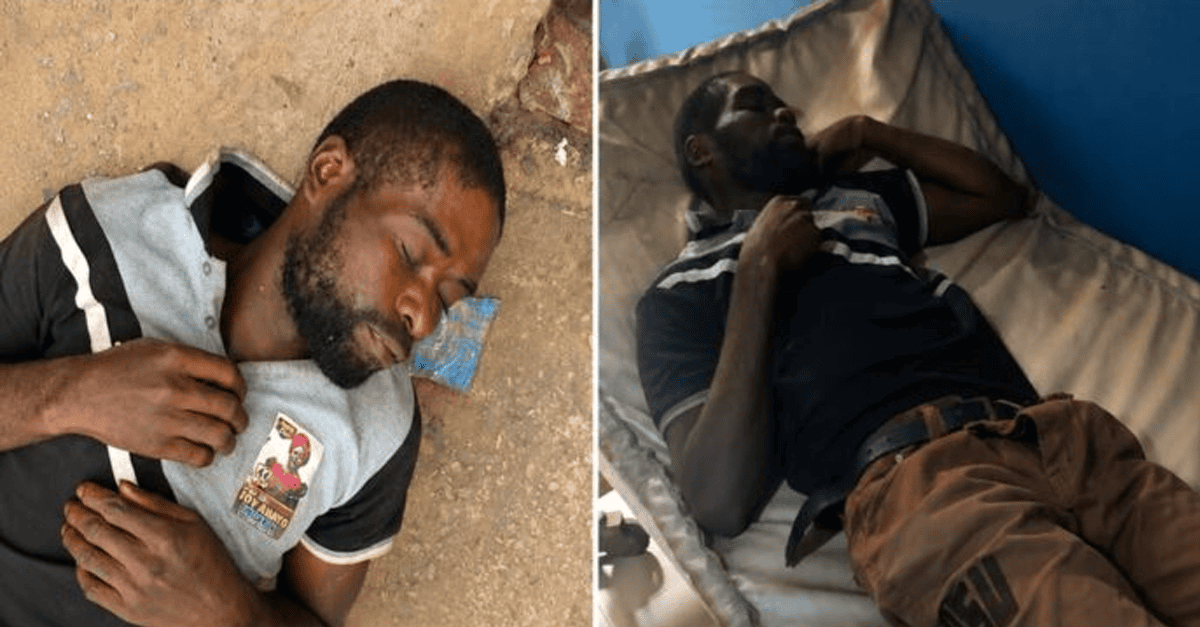
The Anambra State Police Command has launched an appeal for public assistance after an unidentified man was found unconscious on a roadside in Awka, the state capital. The incident, which occurred on a busy stretch of road, has raised concerns about the prevalence of drug abuse and the vulnerability of individuals without family support. Police suspect the man may have been under the influence of illicit substances, but investigations are ongoing to determine the exact cause of his condition.
The Discovery and Immediate Response
According to police sources, the man was discovered by passersby at about 6:15 a.m. on Wednesday, March 19, 2025, lying motionless near the Zik Avenue area of Awka, a bustling commercial corridor that connects the government secretariat to the main market. Witnesses reported that he showed no signs of physical injury but appeared disoriented and unresponsive. A local trader, Chukwudi Okafor, who was opening his shop nearby, said he first noticed the man slumped against a lamppost. “I thought he was a drunkard sleeping it off, but when I called out and he didn’t move, I knew something was wrong,” Okafor told reporters. He and another passerby, a nurse named Amara Nwosu, checked the man’s pulse and found it weak. Nwosu called the emergency numbers for the Bompai Police Division, which is about 1.5 kilometers away. Officers from the division, led by Inspector Musa Yusuf, arrived at 6:32 a.m., according to the police incident log. They provided first aid by placing the man in the recovery position and covering him with a blanket. An ambulance from the Anambra State Ministry of Health arrived at 6:45 a.m. and rushed the man to the Chukwuemeka Odumegwu Ojukwu University Teaching Hospital (COOUTH) in Awka, where he is currently receiving medical attention.
Police spokesman DSP Tochukwu Ikenga confirmed the incident in a statement, noting that the man was found in a state of unconsciousness and that preliminary assessments suggest drug intoxication may be a factor. “We are appealing to members of the public who may have information about this individual or his family to come forward,” Ikenga said. “His condition is stable, but we need to reunite him with his loved ones.” Hospital sources say the man remains in the intensive care unit, where doctors have administered activated charcoal and intravenous fluids to counter possible drug overdose. Toxicology tests are pending at the National Agency for Food and Drug Administration and Control (NAFDAC) laboratory in Enugu.
A Growing Problem: Drug Abuse in Anambra
This incident highlights a broader issue in Anambra State and across Nigeria: the rising tide of drug abuse among young and middle-aged adults. The National Drug Law Enforcement Agency (NDLEA) has repeatedly warned about the proliferation of substances like methamphetamine, codeine, and cannabis. In 2023 alone, the agency arrested over 1,200 suspects in the South-East region and seized significant quantities of illicit drugs, including 2,300 kilograms of cannabis and 1,500 bottles of codeine syrup. The NDLEA’s 2024 annual report, released in January 2025, showed a 15% increase in drug-related arrests in Anambra compared to the previous year, with 487 arrests made in the state. The most commonly abused substances among those arrested were cannabis (42%), codeine (28%), and tramadol (19%).
Awka, as a rapidly urbanizing city with a population estimated at over 500,000, has not been immune to this trend. The city’s nightlife and unregulated drug markets have created a fertile ground for substance abuse. Social workers and health officials have noted an increase in cases of individuals found incapacitated in public spaces. At COOUTH, the emergency department sees an average of three to four cases of drug overdose per week, according to Dr. Ifeanyi Eze, a consultant physician who spoke on condition of anonymity. “Many of these patients are brought in by Good Samaritans or police. They are often dehydrated, confused, and have no identification,” Eze said. The lack of adequate rehabilitation centers and community support systems exacerbates the problem, leaving many to fend for themselves. Anambra has only two functional drug rehabilitation centers: one run by the federal government in Onitsha and a private facility in Awka called New Dawn Rehabilitation Home, which has a capacity of just 40 beds. The state government’s proposed 200-bed rehabilitation center in Nnewi, announced in 2022, remains under construction due to funding delays.
The Human Angle: A Man Without Identity
The unidentified man’s plight also underscores the challenges faced by individuals who lack identification or family networks. In Nigeria, many people do not possess official documents such as National Identification Numbers (NIN) or driver’s licenses. According to the National Identity Management Commission (NIMC), as of December 2024, only 60% of Nigeria’s estimated 220 million population had enrolled for the NIN. In Anambra, the enrollment rate is slightly higher at 65%, but many residents, especially those in rural areas and informal settlements, still lack documentation. This makes it difficult for authorities to trace their backgrounds or notify relatives. The man’s condition – unconscious and without any personal effects – has left police with few leads. He was not carrying a wallet, phone, or any identification. His clothes had no labels that could indicate a brand or store. Police have checked missing persons reports across the South-East region for the past two weeks but found no match. They have also circulated his photograph to hospitals and mortuaries in neighboring states like Enugu and Delta.
Community leaders have called for better systems to track vulnerable individuals. “This is not an isolated case,” said Chief Emeka Okonkwo, a community elder in Awka and chairman of the Awka Development Union. “We see people wandering the streets, and no one knows where they come from. We need a database for missing persons and better collaboration between hospitals and the police.” Okonkwo cited a similar case in January 2025, when a woman found unconscious at the Awka main market was later identified as a mother of three from Umuawulu village, but only after she had spent three weeks in the hospital. “If we had a central registry, we could have reunited her with her family in days, not weeks,” he said.
Police Appeal and Public Response
The police have released a description of the man: he is estimated to be in his late 30s, about 5 feet 8 inches tall, of average build, with a dark complexion and short black hair. He was wearing a blue short-sleeved shirt with a collar, black trousers, and brown sandals at the time of discovery. He has no visible tattoos or scars, except for a small mole on his left cheek. They have asked anyone with information to contact the Bompai Police Division at 080-1234-5678 or the state command’s emergency hotline at 112.
So far, no family members have come forward. The public has responded on social media, with many sharing the police bulletin and expressing concern. On Twitter, the hashtag #FindHisFamily has been trending in Anambra, with over 5,000 posts as of March 21. Some users have criticized the police for not doing more to identify the man, while others have praised the swift response. Human rights activists have also weighed in, urging the government to invest in mental health and drug rehabilitation services. The Civil Liberties Organization (CLO) in Anambra issued a statement calling on the state government to “declare a state of emergency on drug abuse” and allocate at least 5% of the health budget to addiction treatment.
A Call for Systemic Change
This incident is a stark reminder that drug abuse is not just a criminal issue but a public health crisis. The man found on the roadside is not alone – he represents countless others who struggle with addiction without support. The Anambra State Government has announced plans to establish more rehabilitation centers, but progress has been slow. In his 2025 budget speech, Governor Charles Soludo allocated ₦500 million for drug abuse prevention and treatment, a 25% increase from the previous year. However, critics argue that the amount is insufficient given the scale of the problem. The state’s Ministry of Health has partnered with the NDLEA to conduct community outreach programs, but these reach only a fraction of those in need.
Meanwhile, the police continue their search for answers. For now, the man remains in hospital, his identity a mystery. The hope is that someone will recognize him and reunite him with his family. But the larger question remains: what can be done to prevent such incidents from happening in the first place? Experts suggest a multi-pronged approach: expanding access to rehabilitation, strengthening family support systems, and improving public awareness about the dangers of drug abuse. Until then, the streets of Awka will continue to hold secrets like the man without a name.
Summary
An unidentified man was found unconscious on a road in Awka, Anambra State, and police suspect drug abuse may be the cause. The incident highlights the growing problem of substance abuse in the region and the challenges of identifying individuals without family or documentation. Authorities are appealing for public help to locate his relatives as the man receives medical care.