
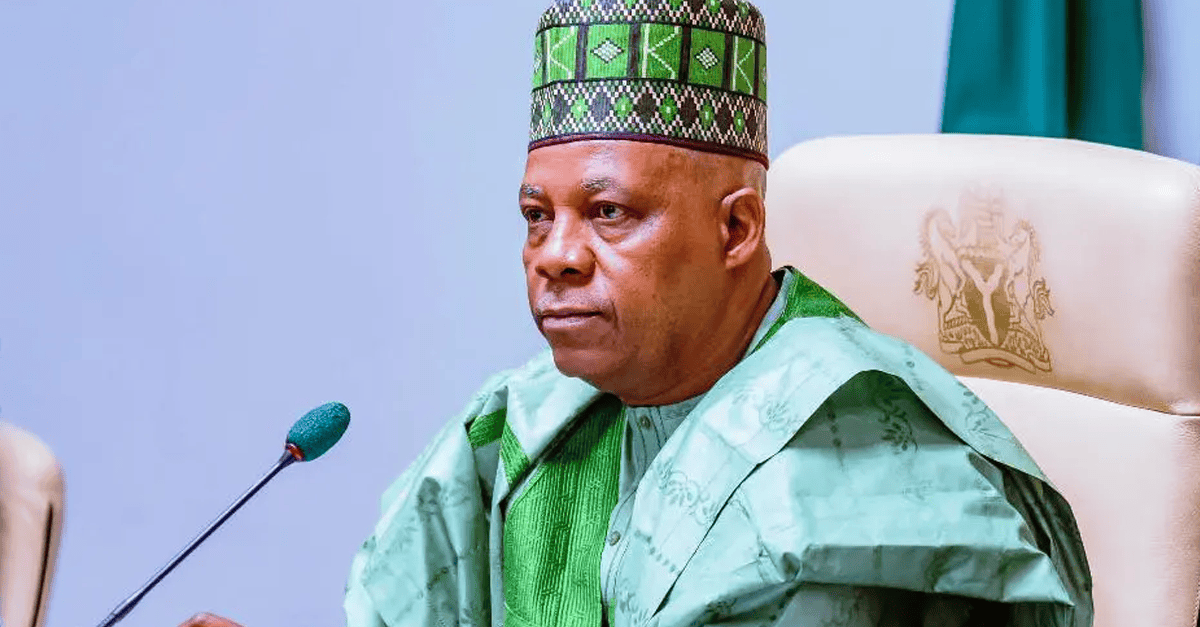
The countdown to Nigeria's 2027 presidential election has begun, and for Vice President Kashim Shettima, the stakes have never been higher. Depending on the outcome of the 16 January poll, Shettima may soon face his final test: whether he can transcend the institutional weakness of the vice presidency and emerge as a credible national leader. The path is littered with cautionary tales, none more instructive than the odyssey of Atiku Abubakar under President Olusegun Obasanjo. Shettima, however, has resources that his predecessors lacked. The question is whether he can use them wisely.
The weight of history
Nigeria's vice presidency has long been a graveyard of political ambition. From Alex Ekwueme under Shehu Shagari to Atiku under Obasanjo, and from Goodluck Jonathan under Umaru Yar'Adua to Yemi Osinbajo under Muhammadu Buhari, the office has often been a gilded cage. The occupant is expected to be loyal, visible but not too visible, powerful but not threatening. Shettima, a former governor of Borno State, understands this balancing act. He has maintained a low profile since taking office in May 2023, rarely making headlines unless circumstances demand it. Yet the 2027 election will force him into the spotlight. If President Bola Tinubu seeks re-election, Shettima will be his running mate. If Tinubu steps aside, Shettima could be the standard-bearer. Either way, the vice president must prepare for a reckoning.
Atiku's experience under Obasanjo from 1999 to 2007 offers a stark warning. Atiku was a powerful vice president, with control over the economic management team and a national political network. Yet Obasanjo sidelined him after their falling out, backed a third-term agenda that Atiku opposed, and eventually forced him out of the ruling party. Atiku's ambition was seen as a threat, not an asset. Shettima faces a similar dynamic. His boss, Tinubu, is a political heavyweight who brooks no rivals. The president has already shown he is willing to crack the whip, as seen in the 2023 primary where he outmanoeuvred all challengers. Shettima must navigate this minefield without triggering the president's suspicion.
The resources Shettima can draw on
Shettima is not without advantages. His tenure as governor of Borno State from 2011 to 2019, though marred by the Boko Haram insurgency, earned him a reputation for competence and calm. He is widely seen as a technocrat, with a PhD in English and a background in banking. This contrasts with the rough-and-tumble of Nigerian politics, where charisma often trumps expertise. He also benefits from a strong relationship with Tinubu, who chose him as running mate despite pressure to pick a Christian from the South-East. That decision was a gamble, but it has paid off so far. Shettima has not embarrassed the president, and he has used his position to maintain ties with northern elites.
Another resource is the changing political landscape. The 2023 election showed that ethnic and religious voting blocs are fracturing. Peter Obi's Labour Party drew support from Christians and the South-East, while Atiku's PDP relied on the North. Shettima, a Muslim from the North-East, can appeal to a broad coalition if he positions himself as a unifier. He also has the advantage of incumbency, which provides access to patronage and media visibility. But incumbency can be a double-edged sword. If the economy remains sluggish, Shettima will share the blame.
The pitfalls ahead
Shettima's biggest challenge is credibility. The vice president has been accused of being a silent partner in a government that has faced criticism over economic hardship, insecurity, and policy missteps. The removal of fuel subsidies and the floating of the naira have caused pain, and while these reforms may be necessary, they are unpopular. Shettima must convince Nigerians that he is not just a cheerleader but a leader with his own ideas. He must also distance himself from any scandals that may emerge. The 2027 campaign will be brutal, and opponents will dig up every misstep.
Another pitfall is the Tinubu factor. If the president runs for a second term, Shettima will be relegated to the background. If Tinubu does not run, Shettima will face a crowded primary field. The president's endorsement will be crucial, but it may come with strings attached. Shettima must decide whether to be a loyal deputy or to strike out on his own. History suggests that vice presidents who challenge their bosses rarely succeed. Atiku failed. Osinbajo tried and failed. Shettima may be wiser to wait his turn.
Specific challenges from the economy and security
Nigeria's economy is under severe strain. According to the National Bureau of Statistics, inflation hit 28.9% in December 2023, the highest in nearly two decades. The naira has lost over 40% of its value since the June 2023 float. Food prices have surged, with a bag of rice costing N65,000 in Lagos, up from N35,000 a year earlier. These numbers are not abstract; they translate into real hardship for millions. Shettima, as chairman of the National Economic Council, has a front-row seat to these crises. He must articulate a clear economic vision that goes beyond defending the status quo.
On security, the picture is mixed. While the military has made gains against Boko Haram in the North-East, banditry and kidnapping have spiked in the North-West and North-Central. In 2023 alone, over 3,000 people were killed in bandit attacks, according to the Nigeria Security Tracker. Shettima, a native of the North-East, cannot afford to be seen as indifferent to these tragedies. He needs to propose concrete measures, such as community policing initiatives or dialogue with armed groups, to show he is a leader who can protect lives.
The Atiku parallel: A deeper look
Atiku Abubakar's trajectory under Obasanjo is a case study in political ambition gone wrong. Atiku, a former customs officer and businessman, was a formidable vice president. He controlled the National Council on Privatisation and oversaw the sale of state-owned enterprises like NITEL and the Lagos International Trade Fair Complex. But his relationship with Obasanjo soured after the 2003 election, when Atiku began positioning himself for 2007. Obasanjo responded by stripping him of his economic portfolio and backing a third-term amendment to the constitution. Atiku fought back, publicly accusing Obasanjo of authoritarianism, but the damage was done. He lost the PDP nomination in 2007 and was forced to run on the AC ticket, finishing third.
Shettima can learn from Atiku's mistakes. He must avoid public confrontations with Tinubu. Instead, he should cultivate a reputation as a loyal team player while quietly building his own network. Atiku's error was to telegraph his ambition too early. Shettima should be more subtle, using his position to travel, speak, and connect without appearing to challenge the president.
What Shettima must do
To succeed, Shettima must do three things. First, he must build a political identity independent of Tinubu. This means making public appearances, articulating policy positions, and reaching out to interest groups. For example, he could launch an initiative on education or youth employment, similar to the 'Not Too Young To Run' campaign that Osinbajo championed. Second, he must manage the succession question carefully. If Tinubu intends to run again, Shettima should support him wholeheartedly. If not, he should signal his interest early and quietly. Third, he must prepare for a national campaign. The vice president has a strong base in the North-East, but he needs to expand to the North-West and South-West. He should cultivate relationships with governors like Dikko Radda of Katsina and Seyi Makinde of Oyo, as well as traditional rulers like the Sultan of Sokoto and the Ooni of Ife.
Finally, Shettima must learn from Atiku's mistakes. Atiku was seen as too ambitious too soon. He challenged Obasanjo publicly and paid the price. Shettima should be patient, but not passive. He should be visible, but not threatening. It is a narrow path, but one he can walk. The 2027 election will be his final test. If he passes, he could become Nigeria's next president. If he fails, he will be another footnote in the long history of vice presidents who never made it.
The odyssey of Atiku Abubakar is a living reminder that the vice presidency is not a stepping stone but a trap. Shettima has the chance to escape it. The question is whether he has the skill and the luck to do so.